

Your Legal Invoice Data, Brought into Focus
Aperture by Legal Decoder is a natural language interface for legal billing and spend data, built on Legal Decoder’s existing proprietary analytics foundation. Ask Aperture anything about your legal billing data and receive answers with full analytical depth in just seconds.
THE INDUSTRY’S CHALLENGE
Legal invoice data is searchable. That doesn’t make it understandable.
Most legal analytics platforms can search invoices and UTBMS codes. That data is unstructured and doesn't answer what teams need to know.
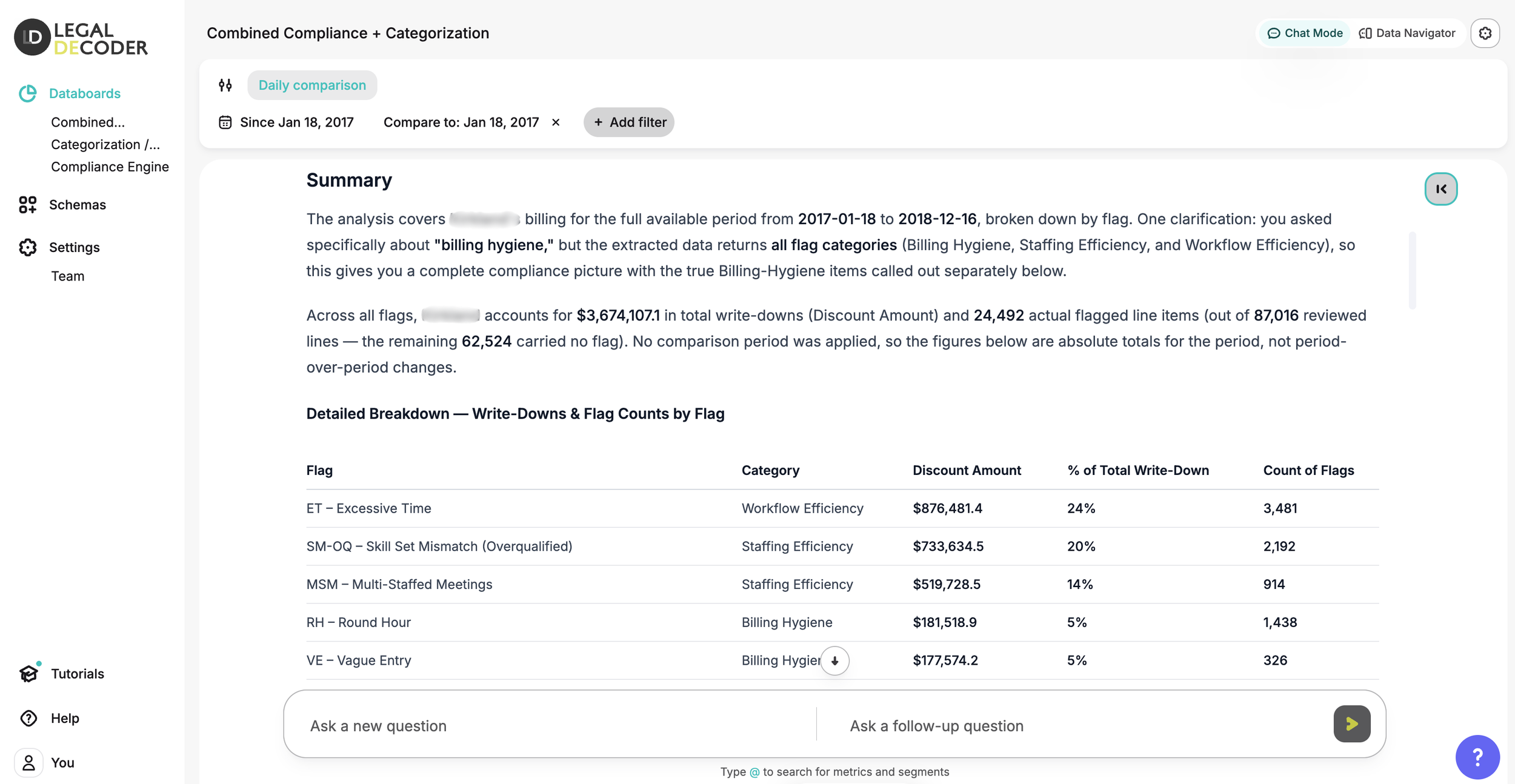
UTBMS codes tell you where time was billed. They don't tell you which tasks drove cost, how work was staffed, or where efficiency broke down. Aperture reveals—in plain language—what actually happened at the matter level, not just how the time was coded.
QUERYABLE INTELLIGENCE
Ask more than your dashboards can answer.
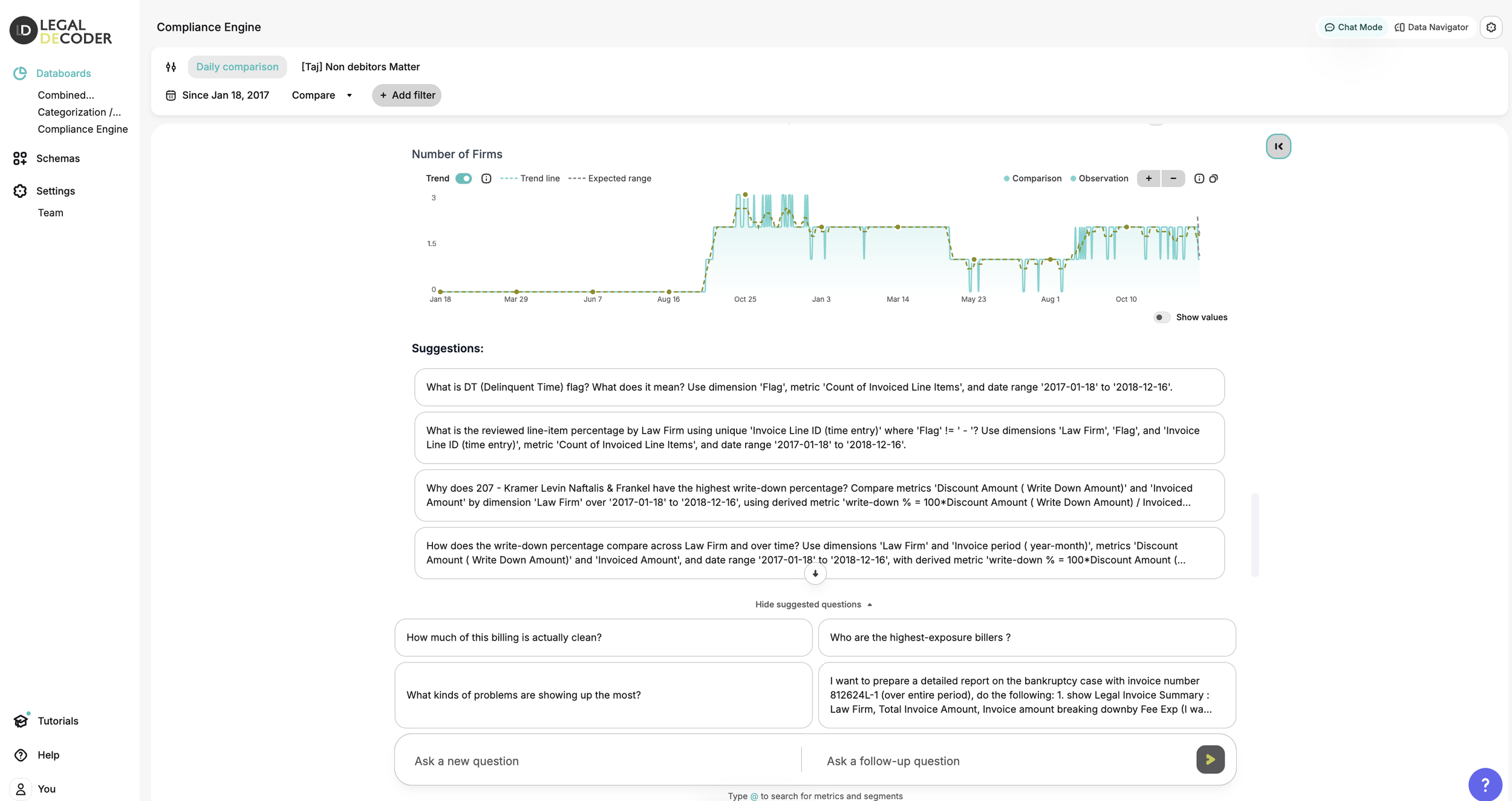
Aperture is designed to help organizations and law firms navigate enormous amounts of legal billing and spend datasets with speed, transparency, and defensibility. Ask all of your burning billing questions and receive analyst-grade insights in seconds.
WHAT MAKES APERTURE UNIQUE
Anyone can add a Q&A layer. The advantage is what sits underneath.
Aperture combines conversational querying with Legal Decoder’s analytics foundation. Users aren’t analyzing raw invoices; they’re interrogating structured legal data.
Before any data is queried, it is:
Parsed
Invoice narratives and billing entries are broken into underlying components for analysis.
Categorized
Each activity is assigned the appropriate task and matter-level classification.
Enriched
Additional context is added to reveal the work performed, how it was staffed, and cost drivers.
Standardized
Inconsistent billing language is normalized into a consistent, comparable format.
Evaluated
The data is checked against compliance rules and analyzed for patterns, efficiency, and risk.
DATA PRIVACY
Tokenize, then analyze.
Before processing any data, Legal Decoder applies pre-LLM tokenization, replacing all identifying markers with secure tokens to protect sensitive information.
To the LLM, this data looks like a string of randomized characters, for example, “Matter_ABCDEF” rather than “M&A – Project Tycoon – 2026.” The AI can still process the language, analyze the metrics, and optimize workflows, but it has zero context regarding who the data belongs to.
Once the data is processed, results are remapped internally to restore business meaning inside Legal Decoder’s controlled environment.
Unlike traditional token vault architectures that maintain persistent mappings over time, Legal Decoder generates unique identifiers at the session level. This ensures the same underlying value is not consistently represented across tokenization runs.
Frequently Asked Questions
-
Aperture does both. By default, it mostly sticks to observations and suggests next steps for continuing the analysis. It can provide a specific action plan when explicitly prompted for one.
-
The following export options are available through Aperture:
Export as PDF: Allows the export of a selected Aperture response, including all the data referenced. Formatting is preserved.
Export as AI Report: Allows the export of a selected Aperture response into a formatted PDF or Word report. The report includes all data referenced and all tables/charts.
Export as CSV or Copy as Table: Copies the underlying data referenced in Aperture’s response but does not include the actual response.
Copy Chat Message or Copy Full Conversation: Allows users to copy a single Aperture response or the entire conversation.
-
Aperture doesn't calculate anything itself. AI agents figure out what data and calculations are needed for your question and later explain the results in plain English. The actual number-crunching is handled entirely by a separate, deterministic compute engine, not the AI. That's what keeps the numbers accurate and consistent every time.
-
Yes. The Analysis Request Breakdown within Aperture’s response explicitly displays the data analyzed in the prompt.
-
Aperture is designed to answer natural language questions about legal invoice data, including billing activity, matters, staffing, and work performed. Built on Legal Decoder’s structured invoice intelligence, it also supports follow-up questions, so you can explore your data conversationally rather than through static reports.
-
Aperture is not a replacement for your existing ELM or e-billing system. It’s a complementary analytics intelligence layer that provides 45+ court-validated billing compliance flags, forward-looking AI pricing benchmarks that demonstrate how AI should compress tasks, and alternative fee analysis built from your own historical data.
-
Aperture is not generative AI; it is purpose-built for legal spend analysis. By combining a natural language interface with Legal Decoder’s proprietary invoice intelligence, Aperture allows users to interrogate their invoice data conversationally and receive answers grounded in a structured understanding of legal work.
-
Potentially sensitive fields, such as matter names, client names, and attorney names, are encrypted before any data reaches our AI model. Tokens cannot be reverse-engineered and are reset at the session level to ensure the same underlying value is not consistently represented across tokenization runs.
-
No. Any data process through Legal Decoder’s analytics engine and Aperture is used solely for your own business purposes. It is never used to train models.
-
Users only have read permissions which means they cannot write/delete/alter data in the system.
-
Aperture is not a system of record and does not store, own, or serve as the repository for your billing information. Your ELM or e-billing system should remain the authoritative source.
-
Aperture is designed to be intuitive, allowing users to interact with invoice data conversationally rather than through specialized reporting tools. Since Aperture understands the structure and context of legal billing data, it guides users toward meaningful answers.
-
Aperture is built to evolve alongside the legal industry. As billing guidelines, client expectations, and market practices change, Legal Decoder continuously enhances its underlying analytics and domain-informed intelligence to reflect those developments.
Ready to see the future of legal invoice review?
Schedule a product walkthrough