
How Legal Decoder Helped Shape an AmLaw 100 Firm's Risk Management Initiative
The General Counsel’s Strategic Initiative and Its Challenges
What do prudent general counsel of law firms do when they want to make sure that their risk management systems—as they relate to billing behavior—are best- in-class? The General Counsel of one AmLaw100 Firm decided to be proactive to make sure that his Firm was at the top of its game.
Based on anecdotal feedback, objective observations of industry-wide billing challenges, and his own intuition, the General Counsel astutely wondered whether there could be risk management issues resulting from billing practices of some of the legal professionals at the Firm. He knew that a thoughtful, objective, and critical analysis of billing records would highlight which legal professionals at the Firm had billing practices that were exceptionally good, and which ones needed improvement, all for the ultimate benefit of the Firm’s clients. And he was certain that the last thing that he wanted for his Firm was to be blindsided by an overbilling/billing fraud scandal of the type that makes headline news in every legal industry media outlet.
His five main objectives were to:
1. Reduce exposure to allegations of overbilling or billing fraud.
2. Improve billing/collection realization through better billing practices and fewer write-offs.
3. Ensure client satisfaction through improved compliance with client billing guidelines.
4. Identify, educate, and monitor legal professionals at the Firm who warranted additional (re)training on ethical billing practices and his state’s version of ABA Rule 1.5.
5. Ensure continued compliance with the supervisory duties inherent in his state’s version of ABA Rules 5.1 and 5.3.
He knew that this initiative would be virtually impossible to complete manually, given the volume and scope of the data that had to be analyzed, so he turned to two experts in the field.
An Ideal Solution for the General Counsel
The General Counsel looked to a team consisting of Legal Decoder and Professor Nancy B. Rapoport from the University of Nevada, Las Vegas, Boyd School of Law to help him effectuate his risk management initiative.
Legal Decoder is a legal spend data analytics software company which has developed proprietary Legal Spend Authentication technology (“LSA Technology”) that analyzes huge volumes of billing data in a fraction of the time that it would take a human to complete. LSA Technology analyzes billing/invoice data and professional biographical data on a line-item-by-line-item basis and then flags problematic billing behaviors and inefficiencies when an algorithm is triggered. Each of the 47 different “flags” that could attach to a line-item time entry highlights a problem with staffing efficiency, workflow efficiency, or “billing hygiene” (i.e., clear accurate, and timely timekeeping). In the worst case, the underlying behaviors triggering the flags could lead to overbilling and fraud allegations. Based on the rule algorithms and the resulting flags that have been triggered by a legal professional’s time entries, an overall score—called the LD Loss Prevention Rating—is generated for each legal professional.
Professor Rapoport is an expert in the fields of Legal Ethics, Law Firm Governance, and Ethical Billing Practices. Professor Rapoport has served as a Fee Examiner and Expert in some of the most high-profile bankruptcy cases in history and has been a testifying expert in several state and federal cases involving large, midsize, and boutique law firm behavior. She has also co-authored several articles with Legal Decoder’s founder, Joe Tiano, one of which was published in the University of Pennsylvania Journal of Law & Public Policy, entitled “Using Data Analytics to Predictan Individual Lawyer’s Legal Malpractice Risk Profile:Becoming and LPL Precog.” This law review article is the academic foundation upon which the LD Loss Prevention Rating has been built.
The combined forces of Legal Decoder’s LSA Technology and LD Loss Prevention Rating and Professor Rapoport’s domain expertise and practical judgment made the choice easy for the General Counsel.
The Approach and Analysis to Crunching the Data
Professor Rapoport and Legal Decoder encouraged the General Counsel to run the analysis using a staged approach, starting with a single practice group and then strategically branching out on a firmwide basis. The Firm decided to first start with billing data emanating from Group A. The analyzed data came from fifteen high value matters from the prior 30 months, involving nearly 300 legal professionals, which included both Group A and non-Group A members. Legal Decoder’s software analyzed about 100,000 line-items of data from over 300 invoices, totaling almost $80.0 million of billings, on a line-item-by-line-item basis. The goal of the first stage of programmatic analysis by Legal Decoder was to show questionable time entries or billing habits that are or could be viewed as irregular, atypical, problematic, or otherwise inconsistent with accepted industry practices or with the rules of legal ethics. In the second stage, Professor Rapoport (together with Legal Decoder’s personnel) assessed the automated results from Legal Decoder’s software. Legal Decoder’s LSA Technology and LD Loss Prevention Rating are objective, neutral, and ideally suited for a risk management initiative, but they do not consider “soft” factors like context and professional discretion. That is where Professor Rapoport’s expertise came in.
The Results: Scoring and Segmentation Using the LD Loss Prevention Rating
Upon completion of Legal Decoder’s analysis, the Firm’s timekeepers were segmented into several categories based on: (i) the volume and frequency of the Legal Decoder’s “flags” triggered by each legal professional’s line-item time entries and (ii) each legal professional’s individual LD Loss Prevention Rating. The segmentation was approved and augmented by Professor Rapoport’s expertise and judgment.
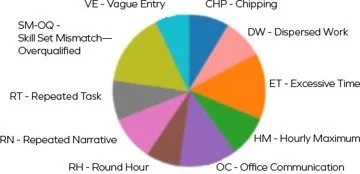
Overall Group A Results: The chart below highlights the most frequent flags in Legal Decoder’s system that were triggered by Group A’s billing data. These flags are synthesized and transformed into Legal Decoder’s LD Loss Prevention Rating.
Most Frequent Flags:
The average LD Loss Prevention Rating was 76.2 (out of 100) and the median LD Loss Prevention Rating was 74.1 (out of 100), both of which are at the industry average. As a starting point, the Firm’s results were solid with nearly 65% of Group A members posing no significant risk management issue and only 8.1% of its members posing a significant risk management issue.
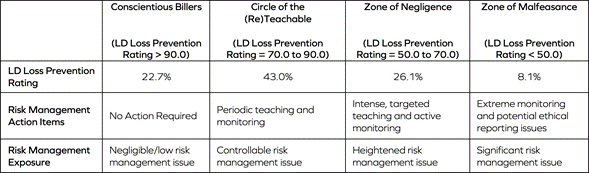
Conscientious Billers: The LD Loss Prevention Rating for approximately 22.7% of the timekeepers indicated that they were conscientious billers who handled legal work and tasks that were suitable for their seniority level and expertise in an industry-benchmarked amount of time without duplication or waste. Their time entries were generally clear and concise and reflected accurately recorded time. This group of professionals could be tapped to train the other professionals in the firm.
Circle of the (Re)Teachable: The LD Loss Prevention Rating for approximately 43.0% of the timekeepers analyzed put them in the “circle of the (re)teachable”: a group of professionals who usually demonstrated billing judgment, billing hygiene, and staffing and workflow efficiency, all of which were usually very good; however, they occasionally showed a proclivity to lapse in the zone of bad billing habits. The bad billing habits closely resemble the problematic behaviors of those in the zone of negligence, but the bad habits are much more fleeting (less recurring), and thus did not trigger heightened concern.
Zone of Negligence: The LD Loss Prevention Rating for approximately 26.1% of the timekeepers analyzed put them in the “zone of negligence”. Timekeepers in the zone of negligence were prone to wasteful processes such as churning files, engaging in excessive internal communications, and doubling up personnel on calls, meetings, hearings, and the like. The timekeepers in the zone of negligence needed to be more conscientious about delegating work to the “lowest efficient legal professional.” However, unlike those in the zone of malfeasance, the mistakes seemed to stem from mere carelessness or an unintentional disregard for good billing practices rather than from something nefarious.
Zone of Malfeasance: The LD Loss Prevention Rating for approximately 8.1% of the timekeepers analyzed put them in the “zone of malfeasance.” Timekeepers in the zone of malfeasance showed a pattern of behavior that suggested potential wrongdoing or ethical violations warranting further investigation by the Firm into the drivers of the questioned behavior. Typically, the “bad habits” of legal professionals in the zone of malfeasance relate to poor billing hygiene, such as a litany of vague entries, delinquently recording time entries, and hoarding work (usually below one’s seniority level) and the bad habits occur at a frequency and level that is hard to attribute to mistake or oversight. However, because there might have been legitimate explanations for some of this behavior, the General Counsel prudently drilled down into each professional’s time entries and spoke with each professional.
Key Takeaways:
Armed with the data and insights from Legal Decoder and Professor Rapoport, the General Counsel proactively implemented an intelligent risk management plan with the following benefits and attributes:
• The General Counsel has proactively addressed a key risk management issue before any financial, ethical or reputation disaster occurs.
• The global solution to the Firm’s risk management issues involves continued training, education, and monitoring, which now can be done on a firmwide, but highly targeted, basis.
• The Firm can tout to clients and prospective clients its data-driven commitment to compliance with client billing guidelines and self-governance when it comes to client value, internal efficiency, and good, ethical billing judgment.
• The Firm can improve profitability by increasing its realization rate and decreasing write-offs by as much as 10.0% or more.
• The General Counsel is now armed with key data points to reduce the cost of legal professional liability (legal malpractice) insurance.
• The General Counsel has isolated and pinpointed pockets of potential risk in a highly targeted, low-friction way.
• The General Counsel will engage in ongoing monitoring, which is critical to show favorable progress.