
Toys ‘R’ Us Bankruptcy
EXECUTIVE SUMMARY
When Toys ‘R’ Us filed its Chapter 11 bankruptcy petition in late 2017, many industry experts predicted that the big winners in the case would be the lawyers and financial advisors. That prediction came true as the final accounting documents filed with the bankruptcy court showed that these professionals expected a $150+ million payday. Final payment, however, only came after close scrutiny of all professional fee applications by Professor Nancy B. Rapoport of the William S. Boyd School of Law at UNLV, with the assistance of Legal Decoder’s legal analytics software platform. Judge Keith L. Phillips, who presided over the Toys ‘R’ Us case, adopted Professor Rapoport’s / Legal Decoder’s recommended fee adjustments and reductions of the initial fees sought.
INTRODUCTION
In high-profile Chapter 11 bankruptcy cases, professional organizations (law firms, financial advisors, accountants, and other consultants) can easily bill a bankruptcy estate hundreds of millions of dollars. The professionals involved in bankruptcy cases represent actual clients (debtor-in- possession, creditor committees, and other constituents), but none of the clients shoulders the full burden of the fees the way that a normal client does in an ongoing engagement. Instead, the Bankruptcy Code transforms a debtor-in-possession from a normal, financially driven business into a fiduciary that stewards a legacy business and assets for the benefit of various creditors. As a result of this structure, professional fees and expenses are paid by the debtor-in-possession from a collective pool of funds without much oversight of the fees or quality of the professional services rendered.
To counteract this phenomenon, the U.S. Trustee, a branch of the U.S. Department of Justice, gets involved. The U.S. Trustee monitors a debtor-in-possession’s operation of the business, specifically assessing applications for compensation and reimbursement by professionals to aid the bankruptcy court in determining whether the fees and expenses of estate-paid professionals are reasonable. In 2013, the U.S. Trustee’s Office published “Guidelines for Reviewing Applications for Compensation and Reimbursement of Expenses Filed under 11 U.S.C. § 330 for Attorneys in Larger Chapter 11 Cases” to establish billing standards and efficient processes to determine if fee applicants have satisfied their burden to justify fees and expenses (the “2013 Guidelines” are available here). Although the 2013 Guidelines don’t have the force of law, they give parties in interest a preview of which categories of fees and expenses the USTP might find objectionable.
The 2013 Guidelines highlight concrete types of problematic billing practices (poor staffing, unapproved rate increases, transitory professionals, block billing or lumping, and vague or repetitive entries, among others) to be avoided. Recognizing that fee applications in large bankruptcy cases are voluminous and challenging to review in detail, the 2013 Guidelines encouraged greater use of fee examiners to help evaluate technical compliance and assess the reasonableness of a professional’s fee request. A fee examiner is guided by the court order establishing the fee examiner’s duties and usually is a bankruptcy expert who is qualified to make judgments about the costs, benefits, and efficiency of a professional. The fee examiner is charged with providing the bankruptcy court with expert opinions about the reasonableness of the fees and expenses submitted for approval. At bottom, technical compliance and reasonableness require professional services to be cost-effectively and efficiently delivered and fee applications to provide ample specificity as to the nature of the work performed.
THE TOYS ‘R’ US CHALLENGE
Judge Phillips appointed Professor Rapoport as the Fee Examiner for the Toys ‘R’ Us bankruptcy case. At the time of her appointment, Professor Rapoport was immediately faced with a backlog of nearly 9 months of monthly fee applications and interim applications totaling tens of millions of dollars, not to mention an ongoing avalanche of invoices on a monthly basis. Every individual line item in every invoice had to be reviewed for compliance with the 2013 Guidelines and meet the Section 330 “reasonableness” standard.
The sheer volume of fee applications prompted Professor Rapoport to seek out a solution to automate the fee application invoice review process. ”Processing speed and capacity, of course, were baseline requirements for any technology. Based on my experience as a fee examiner in other high-profile cases like Caesars Entertainment, I knew that the professional fees would very quickly exceed $100 million. Any fee review that would help a bankruptcy judge required automation and domain- informed technology. I hoped to find a tool that closely aligned with the 2013 Guidelines and afforded me access to industry-wide data and benchmarks,” recalls Professor Rapoport.
THE SOLUTION: LEGAL DECODER’S LSA COMPLIANCE ENGINE
Legal Decoder’s Legal Spend Analyzer (LSA) Compliance Engine exceeded all of Professor Rapoport’s requirements. In terms of automating the invoice analysis process. Legal Decoder’s compliance engine has demonstrated the ability to programmatically analyze approximately 25,000 invoice line items (about $15.0 million in legal fees) in under 10 minutes without human fatigue, variability, or subjectivity. A careful, manual line-item analysis on the same data set would have taken a human being with legal industry domain expertise at least 2,000 hours—perhaps even more. When it came to alignment with the 2013 Guidelines, the LSA Compliance Engine fit the bill, as problematic billing practices could be automatically detected, flagged, and classified.
HOW IT WORKED IN TOYS ‘R’ US
Legal Decoder’s LSA Technology analyzes billing and invoice data to ensure that lawyers and other legal professionals efficiently and cost-effectively handle tasks commensurate with their skill level. It provides data analytics that identify key trends and actionable information as opposed to unenlightening reports.
For Professor Rapoport, the fee review process began when professional organizations delivered to her fee review team fee applications and invoice data for ingestion into a database. After ingestion, Legal Decoder’s LSA Technology, on a line item-by-line item basis, analyzed each legal professional’s biographical data (title, seniority, bar admission, practice specialty, and so forth) and the correlating invoice data for clarity, accuracy, and efficiency. All data was then measured against a set of domain- informed, proprietary rule algorithms developed by Legal Decoder. When data in a legal professional’s line-item time entry triggered a rule algorithm, the algorithm flagged that individual line item. Every problematic billing practice highlighted in the 2013 Guidelines is covered by a flag, and there are approximately 25 additional flags that Legal Decoder has developed. Based on the rule algorithms/ flags that were triggered, every line item could be classified into one of three problem categories (Staffing Efficiency, Workflow Efficiency, and Billing Hygiene). Flags for “Staffing Efficiency” ensure that legal professionals are handling tasks appropriate for their skill level in an industry-benchmarked amount of time. The “Workflow Efficiency” flags identify waste and redundancy in workflow processes. “Billing Hygiene” flags ensure that line items are clear and concise and reflect accurately recorded time.
Flagged line items were aggregated and were “rolled up” in a myriad of ways to give Professor Rapoport a high-level snapshot of the data. Professor Rapoport and her team then undertook a more granular analysis, drilling down on one or more legal professionals or flag types to ultimately reach an individual professional’s line-item entry. She then evaluated whether that line-item was presumptively unreasonable.
Several aspects of Legal Decoder’s solution appealed to Professor Rapoport, who explained, “Legal Decoder allowed me to start with a completely objective analysis, based on industry-wide data, and then I supplemented Legal Decoder’s analysis with my experience and understanding of the nuances of bankruptcy cases. There are times when I overruled Legal Decoder’s automated analysis – it happens only a small fraction of the time, but my judgment and experience occasionally supersede an algorithm. Equally as important, Legal Decoder’s objective analysis allows me to have a data- driven, depersonalized dialogue with the professionals when it comes to the reasonableness of fees. I can show the professionals where they diverge from the norm — even the norm of the behavior in their own firm in that same case.”
AGGREGATE RESULTS
Collectively, 28 professional organizations in the Toys ‘R’ Us case submitted fee applications seeking over $150 million in compensation. The invoices underlying these applications were programmatically analyzed by Legal Decoder with output transmitted to Professor Rapoport for her approval. Even though good trends and bad trends were identified and analyzed by individual and by each professional organization, the results below are generically presented in the aggregate for all professionals.
HOURLY RATE ANALYSIS
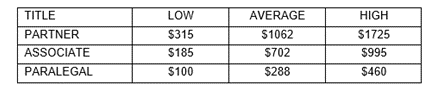
Before embarking on the comprehensive analysis required by the 2013 Guidelines, Professor Rapoport had to assess whether the hourly rates charged by the Toys ‘R’ Us professionals were commensurate with market rates for comparable services. Leveraging Legal Decoder’s data pool, which contains rates for hundreds of thousands of legal professionals, Professor Rapoport reached the conclusion that hourly rates charged by the professionals in the case were reasonable.
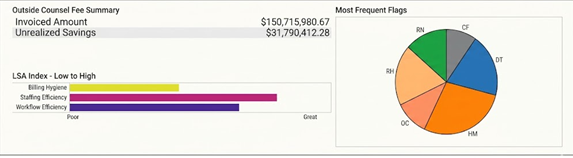
As the LSA Index shows, the Staffing Efficiency and Workflow Efficiency of the professionals were good. This essentially means that most timekeepers handled skill-set-appropriate tasks (Staffing Efficiency) without an abundance of wasted time or duplicated efforts (Workflow Efficiency). In contrast, Billing Hygiene among the entire group of professionals posed a challenge.
BILLING HYGIENE
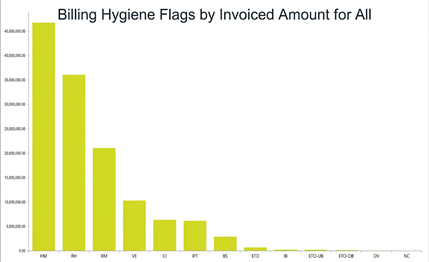
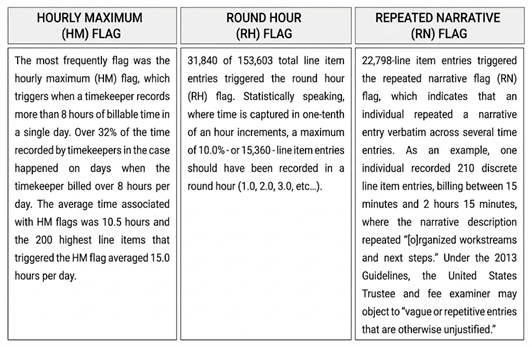
Line items totaling almost $86 million in billings triggered Billing Hygiene flags. More than half (roughly $46 million of line items) of the Billing Hygiene flags triggered on fee applications from the first six months of the case, or approximately one-third of the entire length of the case (and long before Professor Rapoport had been appointed as the fee examiner). Billing hygiene challenges led to considerable reductions in professional fees in the initial stages of the case, but Professor Rapoport worked with the professionals, pointing out where, based on Legal Decoder’s output, the professionals fell short of the mark on the 2013 Guidelines. Professor Rapoport coached all professionals on the standards evidencing exemplary billing hygiene. After the education sessions, billing hygiene improved significantly. For the remaining two-thirds of the case, recommended fee adjustments fell by 50% in the second 6-month period and by another 50% in the last 6-month period.
WORKFLOW EFFICIENCY
Line items totaling $28 million in billings triggered Workflow Efficiency flags. With respect to workflow efficiency, Professor Rapoport was mainly concerned with two things: (a) tasks taking longer than they should have taken according to industry benchmarks and (b) redundancy / duplication of effort. Legal Decoder’s industry benchmarks, which calculates the time required to perform hundreds of thousands of “legal” tasks, allowed Professor Rapoport to determine whether services were performed within a reasonable time commensurate with the complexity, importance, and nature of the problem, issue, or task addressed. Regarding duplication of efforts, Professor Rapoport explained, “The 2013 Guidelines make clear that the United States Trustee or, in my case, the Fee Examiner, may object if any duplication is unjustified or unjustifiable, including when multiple professionals unnecessarily attend hearings or meetings. Legal Decoder’s technology enabled me to identify redundancy both within a single professional organization and across several professional organizations and allowed me to follow up with the professionals involved in an attempt to understand the staffing choices.”
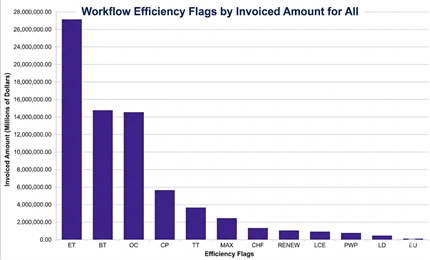
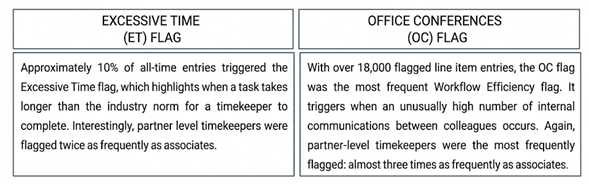
Professor Rapoport noted, “Intuitively, I know roughly how much time a particular task should take, but I don’t think the right approach is to rely on gut hunches. With Legal Decoder, the guesswork around how much time a task should take is eliminated because I could access over a billion in legal spend data.”
STAFFING EFFICIENCY
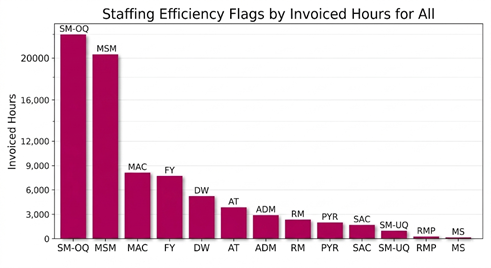
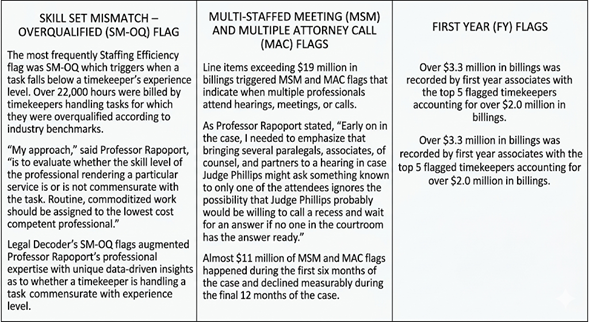
Staffing efficiency measures whether a legal professional has handled a task appropriate to their experience and skill set levels in an industry benchmarked amount of time. The table below summarizes the flags.
CONCLUSION
The Toys ‘R’ Us case illustrates the positive outcome that can result when a seasoned fee examiner and a domain-informed data analytics tool are utilized in a high-profile bankruptcy case. With an approach that focused on legal professional credentials, tasks undertaken and adherence to the 2013 Guidelines, Legal Decoder’s quantitative analyses meaningfully augmented Professor Rapoport’s qualitative expertise, ensuring that clients got maximum value for each dollar paid to law firms and other professional organizations.