

Price an AFA, or Pressure-Test One, From the Same Matter History
AFA.IQ turns a set of historical reference matters into a structured, explainable alternative fee arrangement, with the full calculation chain visible from historical hours to proposed price. Law firms use it to build proposals, and corporate teams use it to validate or gather data for fee negotiations.
INTRODUCING AFA.IQ
What is AFA.IQ?
AFA.IQ is Legal Decoder’s AFA benchmarking and pricing engine. Given a cohort of historical reference matters, it normalizes workload, measures how that workload is distributed, and produces a proposed fixed fee that law firms can trace back to actual matter history and defend, or that a corporate legal team can use to gather evidence-based data for fee negotiations.
Running on structured billing data at the matter, workstream, and timekeeper level, AFA.IQ is built on the same foundation as Legal Decoder’s analytics engine. It uses hours and staffing to standardize and analyze how historical workloads have been distributed across the selected reference matters before proposing a number.
PROPOSE FEE ARRANGEMENTS CONFIDENTLY
Built for both sides of the
pricing conversation
The calculation chain runs whichever side of the table you sit on: a firm building a proposal or a legal team deciding to sign one.
CORPORATE LEGAL
Evaluate an AFA proposal on evidence
Benchmark an outside counsel proposal against your own panel’s historical matters before you sign, with a clear view of what drove matter cost and what the new arrangement assumes.
LAW FIRMS
Build a fee you can defend
Turn your own matter history into a fixed fee or AFA proposal with a visible chain back to real historical workload, instead of anchoring on whichever old matter comes to mind first.
LEGAL PRICING INTELLIGENCE
Historical spend alone can’t price an AFA
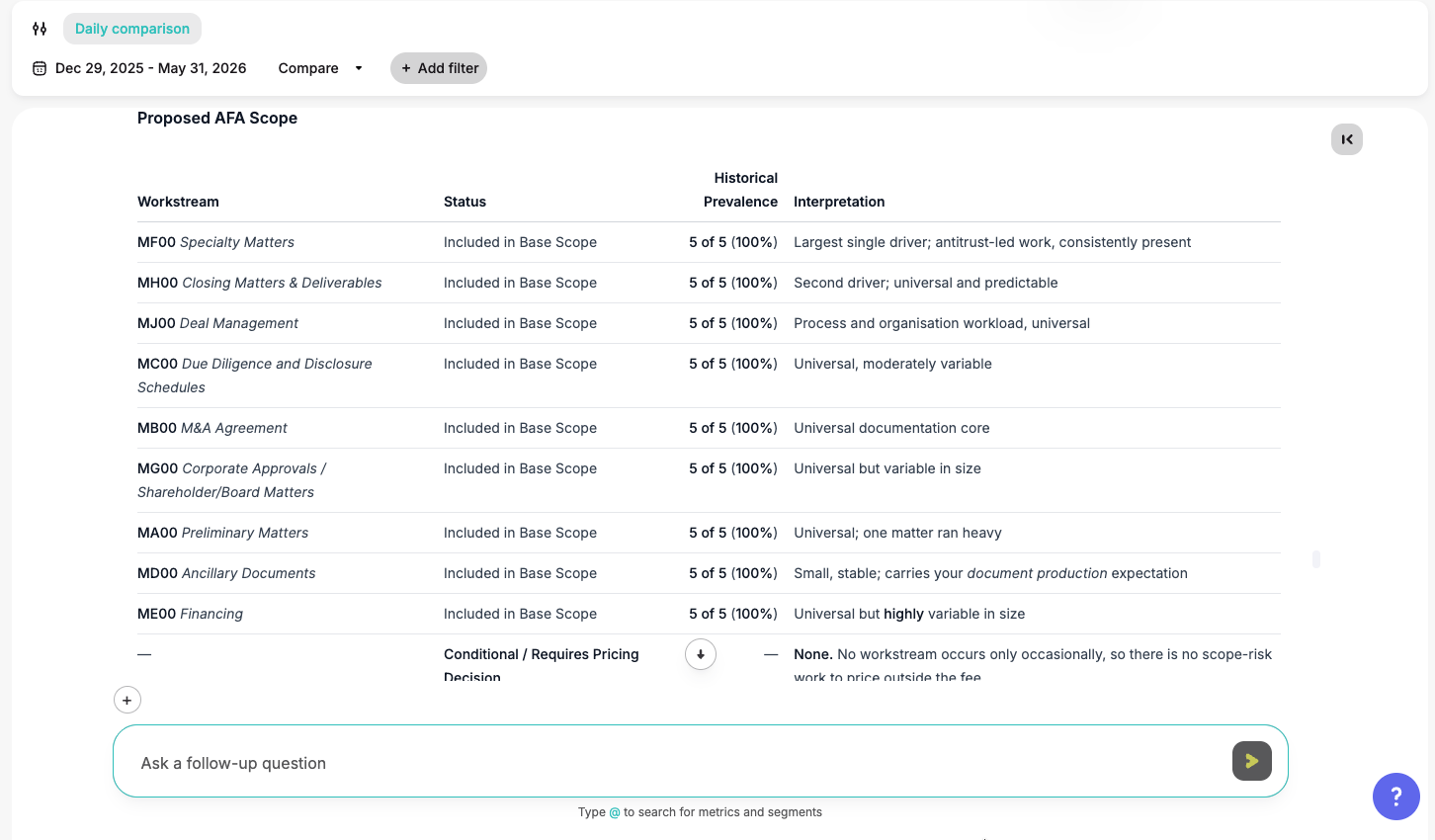
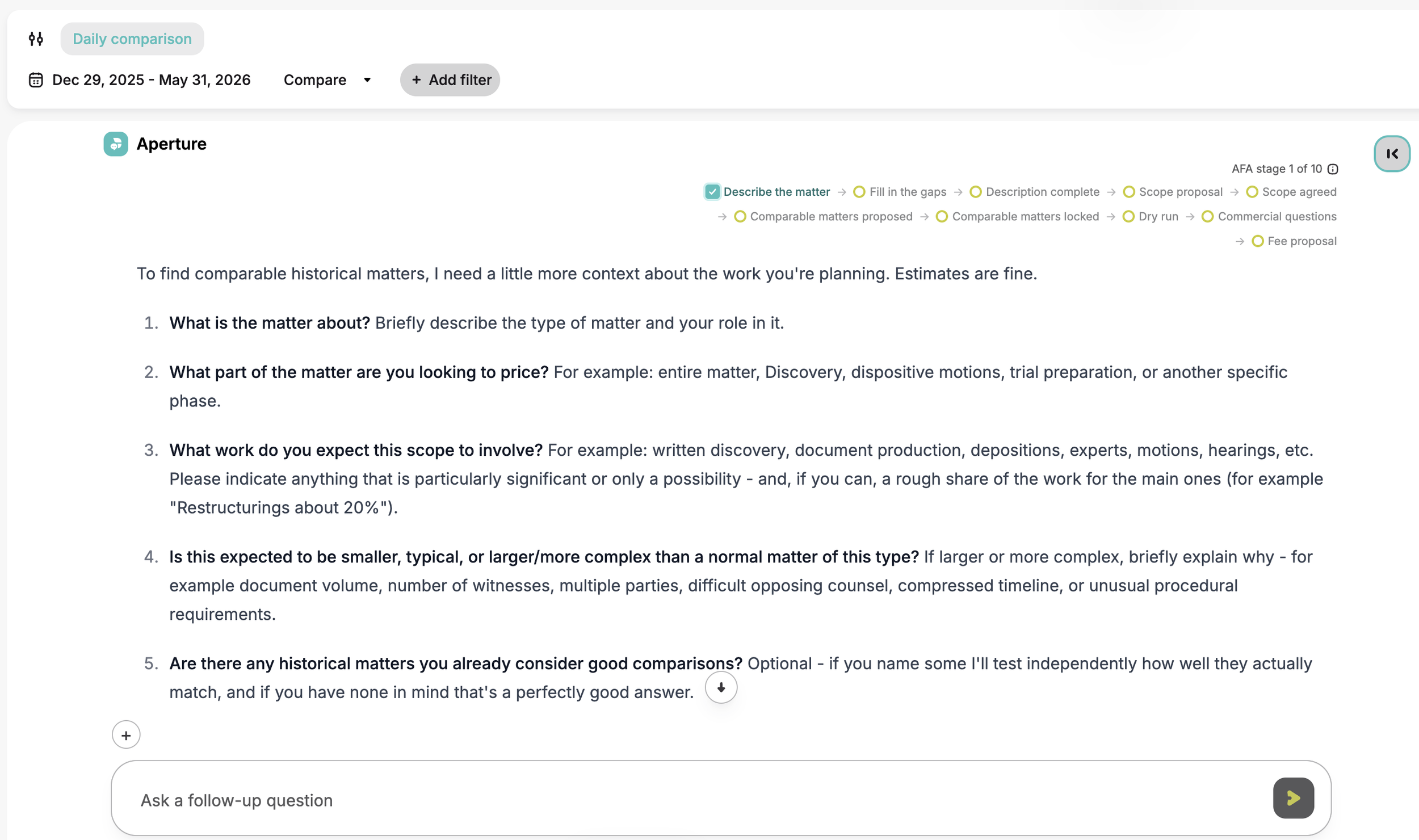
Two historical matters can require the same amount of legal work yet still bill very differently once staffing and rates are factored in. AFA.IQ builds an AFA by undertaking a series of steps before delivering a proposal:
Select benchmark matters
Review proposed scope
Assess standardized workflow streams
Review matter uncertainties
Choose conditional work treatments
Assess risk positions
Apply commercial considerations
Produce AFA
Frequently Asked Questions
-
An alternative fee arrangement is a billing structure for legal work, such as a fixed fee, capped fee, or phase-based fee, used in place of pure hourly billing.
-
Seven historical matters is a workable starting cohort in the current methodology. A small cohort can still provide useful benchmarking evidence, so AFA.IQ reports observed historical ranges and actual reference matters rather than presenting the result as high-confidence statistics.
-
A Relative EWU is a normalized workload scale for a workstream, set so that 1.0 equals the cohort’s median standardized workload for that workstream. It lets AFA.IQ compare workload across matters even when the true number of underlying events isn’t reliably known.
-
Yes. AFA.IQ classifies that work as conditional, reports how often it occurred historically and its typical cost when it did, then lets you add it to the base fee, price it as a separate module, price it per occurrence, or exclude it.
-
No. AFA.IQ provides the historical evidence and a recommended starting point. The specialist still selects the benchmark cohort, chooses how to treat conditional work, picks a risk position, and applies commercial adjustments on top of the analytical benchmark.
-
Historical billing data at the matter, workstream, and timekeeper level, including total hours billed and actual invoiced fees for each combination. Task, activity, and narrative detail are optional and improve scope classification but are not required.
-
Yes. AFA.IQ runs on the same structured, matter-level billing data as the rest of Legal Decoder's products and is built for law firms, corporate legal teams, and bankruptcy fee examiners.
See AFA.IQ in action
Schedule a product walkthrough