

Legal Invoice Analytics That Explains What Every Task Really Cost
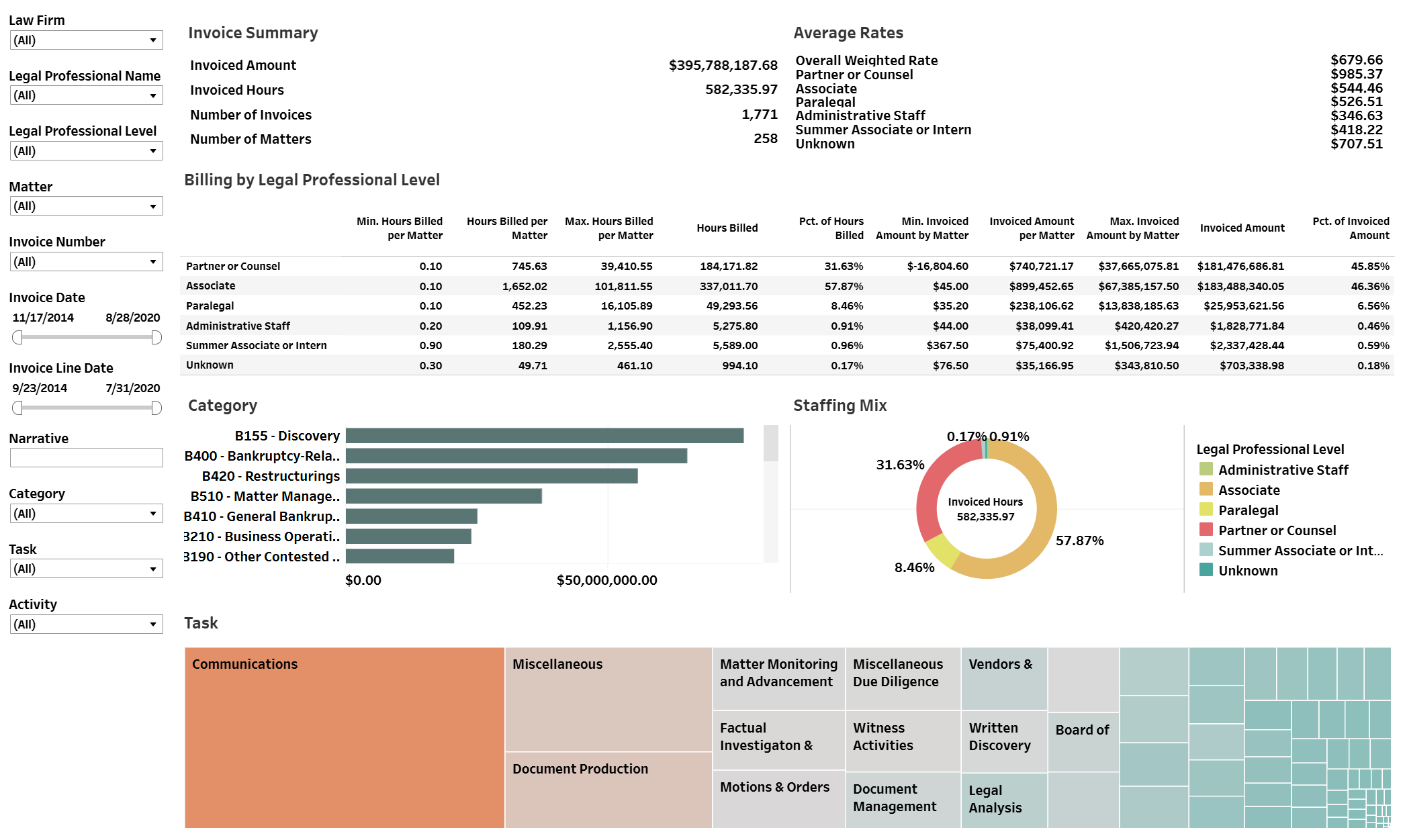
Legal Decoder’s analytics engine is AI-powered legal invoice review technology that reads outside counsel billing narratives and categorizes each time entry at the task level. Legal Decoder helps teams identify cost-saving opportunities, strengthen rate negotiations, and make more informed budget decisions based on how the work was actually performed.
THREE DIMENSIONS OF INSIGHT
The data is in the invoice. The insight is in the pattern.
Everything Legal Decoder does starts in the same place—reading the narrative and re-coding the work at the task level to provide insights on:
Billing Hygiene
Identify billing practices that do not accurately reflect the work performed, including block billing and vague invoice narratives.
Staffing Efficiency
Improve matter economics by identifying whether tasks are handled by the right legal professionals at benchmarked rates and expected time.
Workflow Efficiency
Reduce wasted effort and unnecessary duplication by uncovering workflow patterns and identifying opportunities to streamline processes.
Billions Analyzed
Tens of billions of dollars in fees analyzed across millions of line items from AmLaw 200 firms.

Proprietary Domain Expertise
Built on more than a decade of legal billing research, the engine draws on 411,000 legal concepts and 45+ proprietary analytics flags.

Court-Validated Methodology
The only legal invoice review technology that is vetted and accepted at the federal bankruptcy court level.
Data-Driven Pricing
Align pricing with the work performed to reduce ambiguity, disputes, and budget overruns, and improve business outcomes for both sides.
CONTEXT CHANGES THE ANALYSIS
Every line item has a story.
Every line item can be analyzed against configurable rules and compared across matters, practices, clients, partners, and timekeepers. The result is a consistent, data-driven view of legal work and billing aligned to the guidelines and standards that apply to each organization.
Who did the work?
See the experience level, role, rate, and staffing mix behind each task.
What work was performed?
Analyze invoice narratives at the task level, even when billing practices make the work difficult to isolate.
How long did it take?
Compare time spent on similar work across matters, timekeepers, firms, and historical performance.
What did it cost?
Connect hours, rates, staffing, and task-level activity to understand the true drivers of spend.
Does it align with expectations?
Benchmark actual performance against comparable legal work and identify meaningful variances.
Where are the opportunities?
Uncover patterns in staffing, pricing, and workflows to identify inefficiencies, reduce unnecessary spend, and improve performance.
The value isn’t in the line item alone. It’s in what the line item reveals.
CLEAN INSIGHTS FOR CLEAR DECISIONS
From raw data to smarter pricing decisions.
Break down unstructured invoice data to understand what actually happened at the task level. See how work is performed, how long it takes, and what it costs across matters and firms. Turn that insight into defensible pricing, more accurate budgets, and better-informed decisions about how legal work gets staffed and delivered.
Structured task-level data gives clients and law firms a shared, factual basis for pricing, including AFAs. Every task is accurately categorized and priced, then compared against benchmarks.

Data-Driven Pricing
Align pricing with the work performed to reduce ambiguity, disputes, and budget overruns, and improve business outcomes for both sides.

Faster Invoice Review
Surface potential issues earlier, gain transparency from start to finish, and let your team focus on the matter at hand, not payment administration.

Accountability at Every Stage
Ensure tasks are handled by the appropriate legal professional at an industry-benchmarked price and time.
Frequently Asked Questions
-
eBilling and legal spend management platforms track what was billed and paid. The Analytics Engine adds a deeper layer by reading each invoice line item to identify the task performed, going beyond answering what was paid by telling you why it cost what it did and how similar work could be delivered more effectively.
-
Corporate legal teams use the Analytics Engine to analyze outside counsel invoices at the task level instead of relying on UTBMS codes or manual line-by-line review. The engine re-codes each time entry, factors in outside counsel guidelines, and benchmarks staffing and time against comparable work.
-
Law firms use the Analytics Engine to see their own billing the way clients see it. Task-level data shows where staffing, time, or rates are out of line with benchmarks. Firms can then price matters more accurately, reduce write-downs, and build alternative fee arrangements that hold their margins.
-
Yes. Low realization rates usually come from write-downs and rejected time entries. The Analytics Engine flags guideline conflicts, staffing mismatches, and vague narratives before invoices reach the client, so firms can fix those issues in advance.
-
UTBMS codes are broad categories that timekeepers assign themselves, and they often don’t reflect the specific work performed. The Analytics Engine reads the narrative itself and re-codes work at the task level, which produces far more accurate legal invoice analytics than code-level reporting.
-
The Analytics Engine identifies staffing inefficiencies, billing issues, workflow duplication, unusual time entries, and opportunities to improve cost and performance.
-
The Analytics Engine establishes a baseline of task-level time and costs to identify work AI could replace, accelerate, or leave dependent on human judgment.